


During the use of a swim spa tub, many users encounter a common question: If left unused for a period, how long can the water safely remain sitting in the tub?
This is not a simple matter of "a few days or weeks." Unlike standard bathtubs or temporary inflatable pools, a swim spa tub is a sophisticated piece of equipment designed for continuous, long-term operation—relying heavily on water circulation, filtration, and comprehensive water management systems. Whether the water is "safe to leave unused" depends not merely on the passage of time, but on whether the water remains in a controllable and maintainable state.
A misunderstanding regarding "how long water can sit unused" may lead to:
•Rapid deterioration of water quality
•Increased operational risks for the equipment
•Greater difficulty in cleaning and maintenance
Therefore, clearly understanding how long water can safely remain stagnant within a swim spa tub is a critical component of proper usage and maintenance.
What Does "Water Sitting Unused in a Swim Spa Tub" Actually Mean?
In the context of a swim spa tub, there are typically three distinct states:
1.Completely Unused with No Systems Running
•No active use (swimming or spa)
•No water circulation activated
•No heating activated
•No filtration running
2.Unused, but Maintaining Basic Operations
•No active use (swimming or spa)
•Periodic water circulation
•Filtration system running
•Water body remains under active management
3.Short-Term Pause in Usage
•Intermittent usage
•Equipment activated occasionally
•Water body retains some flow/movement
When people ask, "How long can the water sit unused?" the specific scenario that requires the most caution—and is the true subject of concern—is the *first* state described above.
What Happens If the Water in a Swim Spa Tub Becomes Completely Stagnant?
When water remains in a state of complete stagnation, it undergoes a series of irreversible changes. These changes do not occur "suddenly" or instantaneously; rather, they accumulate gradually over time.
1. The Water Body Loses Its Circulation Capacity
A swim spa relies on its circulation system to:
•Disperse impurities
•Prevent localized water stagnation
•Maintain a uniform state throughout the water body
Once left completely stagnant, the water will exhibit:
•"Dead zones" (areas of stagnant water)
•Sediment accumulation at the bottom
•Localized deterioration of water quality
2. Impurities Begin to Settle
Even when the spa is not in use, the water may still contain:
•Dust
•Microscopic particles
•Residues from the plumbing system
In a swim spa, without circulation, these substances will gradually settle at the bottom and within the plumbing lines.
3. The Water Environment Gradually Becomes Unstable
Stagnant water is prone to:
•Changes in odor
•Decreased clarity
•Inconsistencies between the condition of the surface water and the water at the bottom
These changes may not be obvious at first, but they will continue to accumulate over time.
How long can the water in a swim spa remain stagnant without use?
From a professional maintenance perspective, it is not recommended to leave the water in a swim spa completely stagnant for extended periods.
If a specific timeframe must be provided as a reference:
•Short-term stagnation (3–7 days): Relatively low risk
•Exceeding 1–2 weeks: Risk increases significantly
•Exceeding 1 month with absolutely no operation: Not recommended
It is important to emphasize:
This timeframe does not mean the water will *definitely* "go bad," but rather marks the point at which the associated risks rise significantly.
A swim spa is not designed merely as a vessel for "storing stagnant water," but rather as a system designed for the continuous management of its water body.
Why is a swim spa unsuitable for being left stagnant for long periods?
This is closely tied to the specific structure and functionality of a swim spa.
1. Complex Internal Structure
The interior of a swim spa typically contains:
•A network of plumbing lines
•A jet system
•A filtration loop
If these components remain inactive for an extended period:
•Water becomes trapped within the plumbing lines
•Stagnant zones are easily formed
•Subsequent cleaning becomes significantly more difficult
2. Design Philosophy Differs from Ordinary Swimming Pools
While standard swimming pools can tolerate being left unused for relatively long periods, a swim spa functions more like:
•A closed-loop water system
•A high-circulation-density system
The longer the water remains stagnant, the higher the cost—in terms of effort and resources—to restore it to a usable condition.
If you need to temporarily stop using your swim spa, how should you handle the water?
Rather than leaving the water "completely stagnant," a more sensible approach is to maintain it in a "low-maintenance operational mode." Recommended practices include:
•Maintaining a basic circulation cycle
•Running the filtration system periodically
•Maintaining a minimum level of water flow
The primary objective of doing this is not "usage," but rather preventing the water from spiraling completely out of control.
Even if you do not enter the swim spa tub:
•The water remains "alive"
•The system remains "active"
Will stagnant water in the swim spa tub have a negative impact on the equipment?
Yes—and the impact is often indirect, yet profound.
1. Impact on the Plumbing System
Stagnant water within the pipes tends to:
•Lead to sediment buildup
•Make subsequent cleaning more difficult
•Compromise future water flow efficiency
2. Impact on the Filtration System
If the filtration system remains inactive for an extended period:
•The filter media may dry out unevenly
•The workload on the system increases significantly once it is restarted
3. Impact on the Overall Maintenance Routine
The longer the water remains stagnant:
•The more complex the subsequent recovery steps become
•The more concentrated and intensive the cleaning tasks become
•The higher the overall maintenance costs will be
Therefore, from a maintenance perspective, letting the water sit stagnant is not a "shortcut" to saving effort; rather, it is merely "postponing the trouble."
How long can water remain stagnant in a swim spa tub before it begins to deteriorate noticeably?
Typically:
•Within 1 week: Changes are negligible
•2–3 weeks: Visually perceptible changes begin to appear
•Over 1 month: The water condition becomes clearly undesirable
The rate of this deterioration is influenced by various factors, including:
•Ambient temperature
•Whether the water is being heated
•Whether the tub is covered
•The cleanliness of the surrounding environment
•And many others
However, one thing remains clear:
The longer the duration, the higher the probability that the water quality will decline.
Can using a thermal cover extend the period during which the water can remain stagnant?
It can delay the process, but it cannot extend it indefinitely.
The primary functions of a thermal cover are to:
•Minimize evaporation
•Block out dust and debris
•Reduce external environmental interference
When used on a swim spa tub, a thermal cover can indeed:
•Slow down the rate of water quality deterioration
•Reduce external contamination
However, if the water remains completely uncirculated:
•Internal issues (such as bacterial growth) will still accumulate
•Problems associated with stagnant water within the plumbing lines will persist
Therefore, a cover serves only as an aid; it cannot serve as a substitute for the active operation of the system.
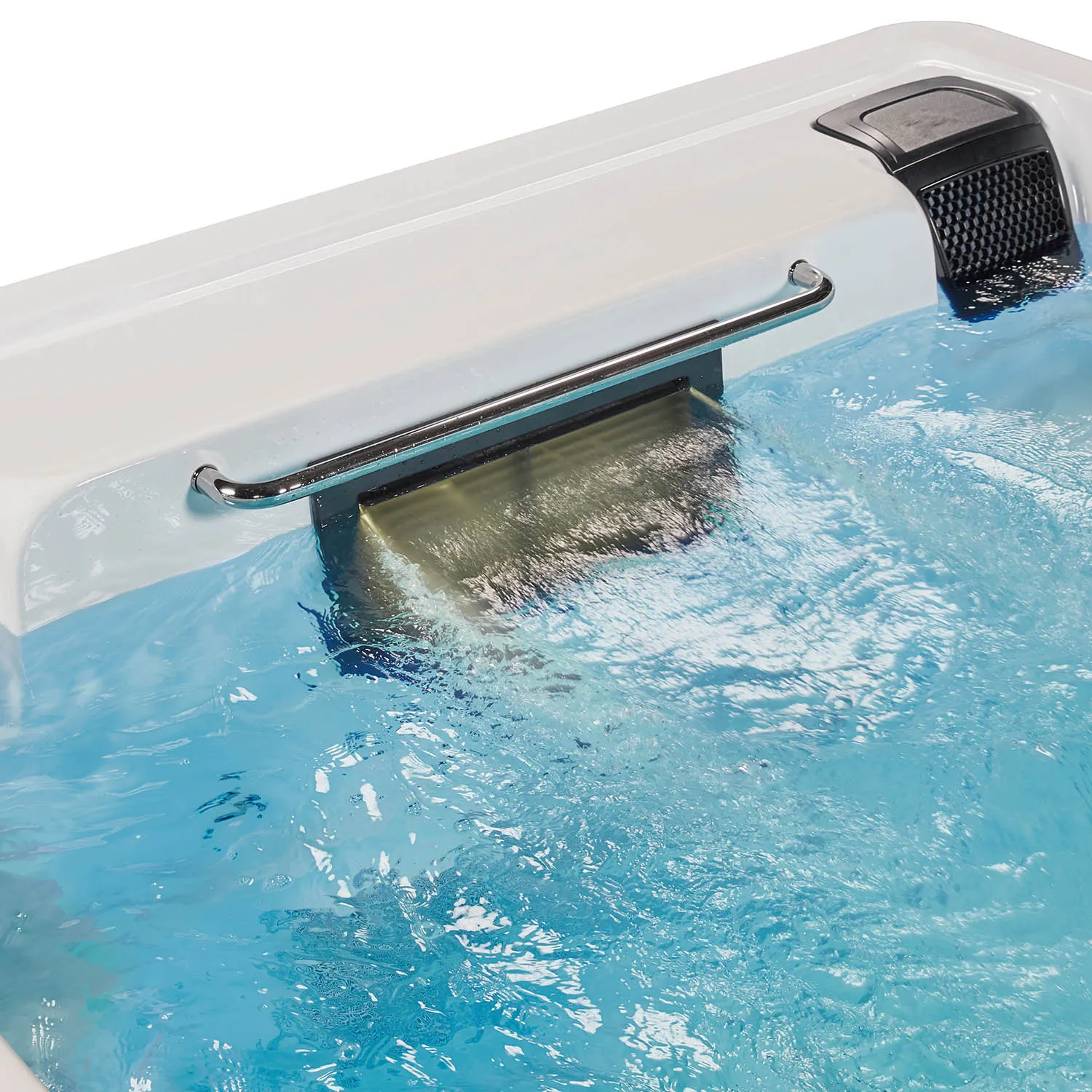
If a swim spa tub is going to remain unused for an extended period, should the water be drained completely?
This is a safer option than simply letting the water "sit idle."
If you know for certain that:
•The unit will remain unused for several consecutive weeks or longer; and
•It is not possible to maintain basic operational cycles;
Then:
•Completely drain the unit;
•Dry out the interior; and
•Shut down the system.
This approach offers far greater control than allowing water to sit stagnant in the swim spa tub for an extended period.
However, this constitutes a "decommissioned state," rather than merely a "temporary pause in use."
Does the permissible "idle time" for the water in a swim spa tub depend on whether it is being heated?
Yes, there is a direct correlation.
•When heated:
Water conditions change more rapidly, so the permissible idle time should be shorter.
•When not heated:
Water conditions change relatively slowly, though changes still occur.
Therefore, if the swim spa tub remains heated while sitting idle:
•It is strongly advised against going for long periods without running the circulation system; and
•Water management becomes particularly critical.
Can the permissible idle time for the water be extended by periodically turning the system on?
Yes, this is a very sensible approach.
Even if you are not actively using the swim spa tub for swimming or hydrotherapy, provided that you:
•Periodically run the circulation system;
•Keep the water flowing; and
•Maintain system operation;
You can significantly extend the period for which the water in the swim spa tub remains usable.
This is far safer than letting the water sit "completely idle."
What is the core principle of water management for a swim spa tub?
Based on the preceding analysis, a core principle can be summarized as follows:
The water in a swim spa tub does not suffer from being "unused," but rather from being "neglected."
As long as the water is actively being managed:
•The permissible idle time can be relatively extended; and
•Potential risks can be kept under control.
However, once the water is left completely unattended:
•The longer it sits, the more problems will arise.