
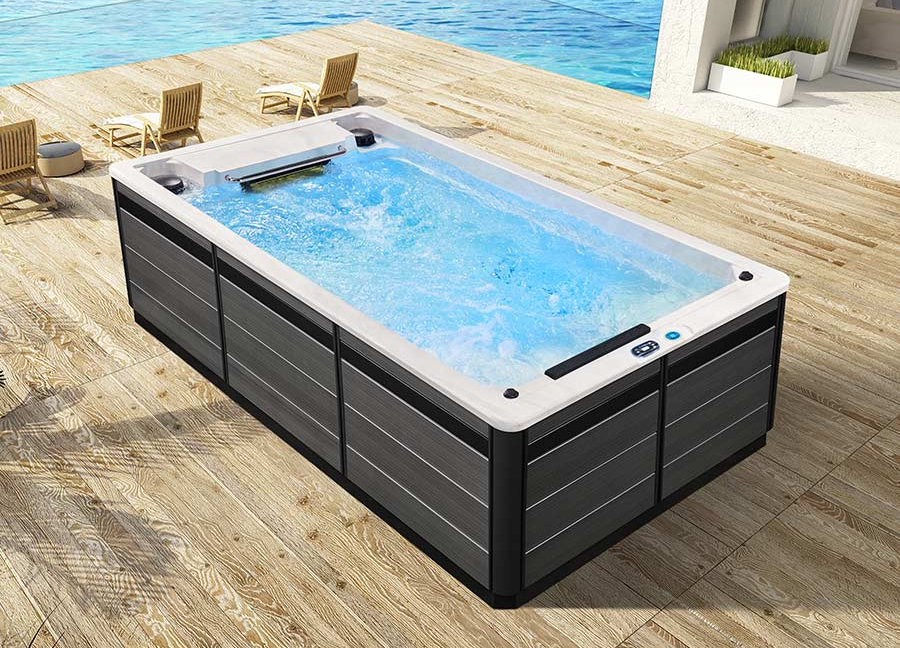
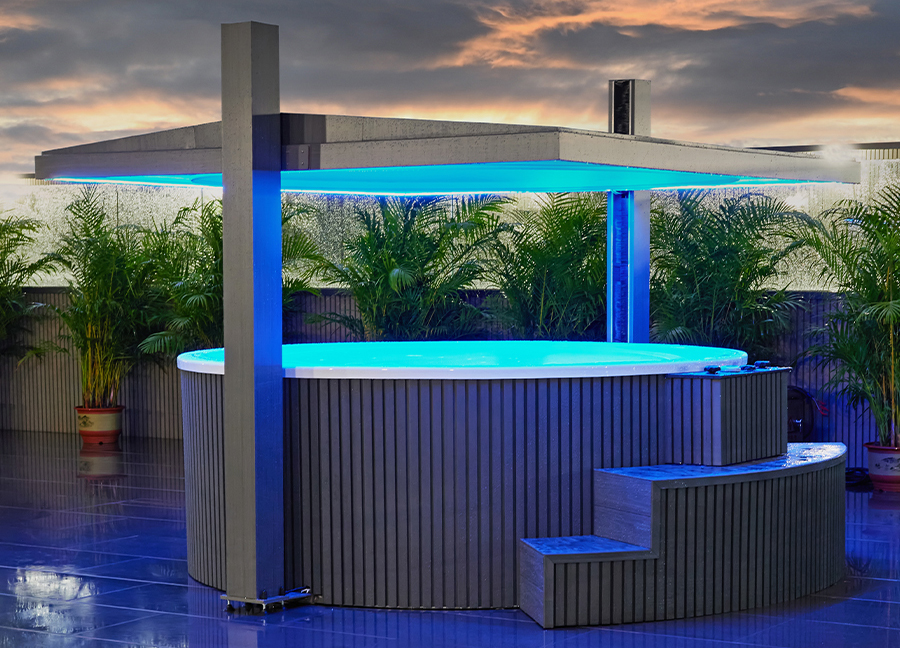


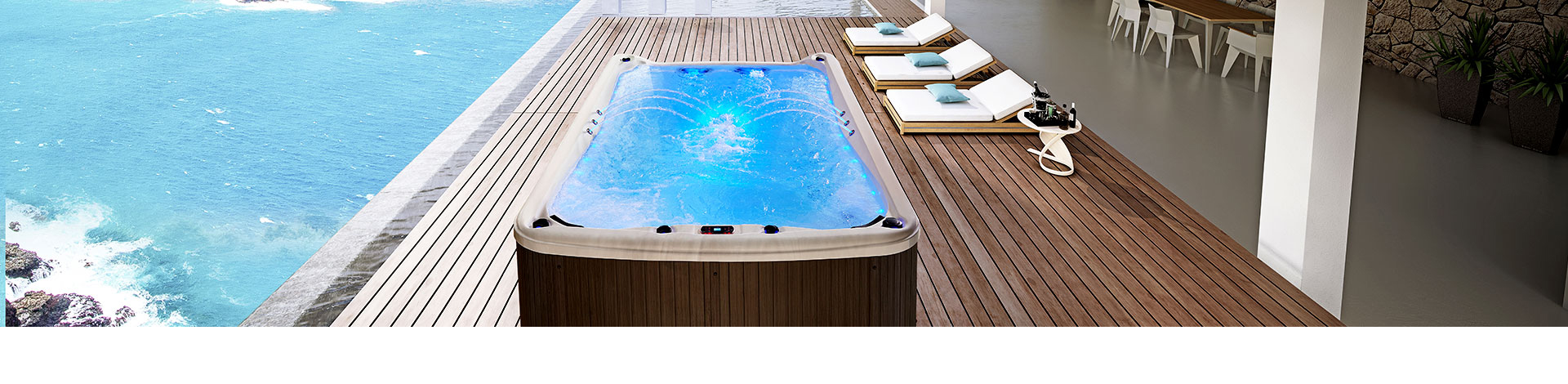
When planning the installation of an outdoor swim spa tub, "what should the ground be like?" is a core question almost every user asks. One of the most common and easily misunderstood questions is: "Does an outdoor swim spa tub have to be placed on concrete?"
Many people subconsciously believe that any heavy equipment must have a concrete foundation.
However, from a professional perspective, the answer to this question is not a simple "yes" or "no."
A concrete surface is not the only option, but it is indeed the safest, most universal, and lowest-risk method.
To truly understand this issue, it is necessary to analyze it from multiple dimensions, such as load-bearing logic, structural stability, long-term safety, and ease of maintenance, rather than just looking at the "ground material."
Why are the requirements for the ground so high for outdoor swim spa tubs?
Before discussing whether a concrete surface is necessary, we must first clarify one premise: The requirements for the ground for swim spa tubs are far higher than for ordinary outdoor facilities.
Key characteristics of swim spa tubs:
• Large size
• High weight
• Extremely heavy when full of water
• Dynamic water flow and human activity during use
• Designed for long-term, fixed placement, not temporary equipment
When a swim spa tub is filled with water and put into use, its total weight typically includes:
• The weight of the tub itself
• The weight of the large volume of water
• The user's weight
• The weight of the internal equipment
This means that the floor must not only be able to "bear" the weight, but also "stablely withstand" it over the long term.
Why is a concrete floor considered the most common choice?
The reason concrete floors are frequently mentioned is not because they are the "only legal" option, but because they perform consistently across several key performance indicators.
The core advantages of concrete floors include:
• High load-bearing capacity
• Even stress distribution
• Resistance to deformation
• Good resistance to settlement
• High long-term stability
For equipment like swim spa tubs, which are statically placed for extended periods and have significant weight when fully filled with water, concrete floors minimize the following risks:
• Ground subsidence
• Uneven stress distribution
• Bathtub deformation
• Water body stress imbalance
Therefore, from a "safety" perspective, concrete floors are indeed the most secure option.
Can outdoor swim spa tubs only be placed on concrete floors?
The answer is: not necessarily, but the prerequisites are very strict.
Swim spa tubs are not "only" placed on concrete floors, but they must be placed on floors that meet the requirements for load-bearing capacity and stability.
Concrete floors are simply the easiest way to meet these requirements.
Theoretically, it is also possible as long as other floor structures can achieve equal or higher stability and load-bearing capacity.
However, the problem is:
Most non-concrete floors struggle to consistently meet these requirements in the long term.
If not placed on a concrete floor, what conditions must the floor meet at least?
This is crucial for determining feasibility.
Regardless of the ground material, if it's used to place a swimming spa tub, the following basic conditions must be met simultaneously:
1. Sufficient Load-Bearing Capacity
The ground must be able to withstand the weight of the swimming spa tub when fully submerged in water for an extended period without:
• Sinking
• Cracking
• Deformation
2. Even Stress Distribution
The ground needs to be generally flat, avoiding:
• Localized Suspension
• Point-like Stress
• Excessive Pressure on Corners
3. Long-Term Stability
Swimming spa tubs are not short-term installations; the ground must remain stable under long-term wind, rain, and temperature fluctuations.
4. Unaffected by Significant Environmental Factors
For example:
• Loose Soil
• Poor Drainage
• Frequent Freeze-Thaw Cycles
These will all affect the long-term load-bearing capacity of the ground.
If the above conditions are not met simultaneously, even if it's "temporarily feasible to place," there are significant risks.
Can swimming spa tubs be placed directly on grass or muddy ground?
This is a very common question, and the answer is very clear: No, they cannot be placed directly.
The reason isn't that "the grass isn't stable," but rather:
• The soil structure beneath the grass is unstable.
• It's susceptible to rainwater damage.
• Long-term weight-bearing can cause subsidence.
• It's difficult to maintain overall levelness.
Even if the swim spa tub seems stable initially, over time:
• The ground will gradually become uneven.
• The equipment will experience stress imbalance.
• Safety of use will decrease.
Therefore, grass or bare soil is unsuitable as a direct foundation for a swim spa tub.
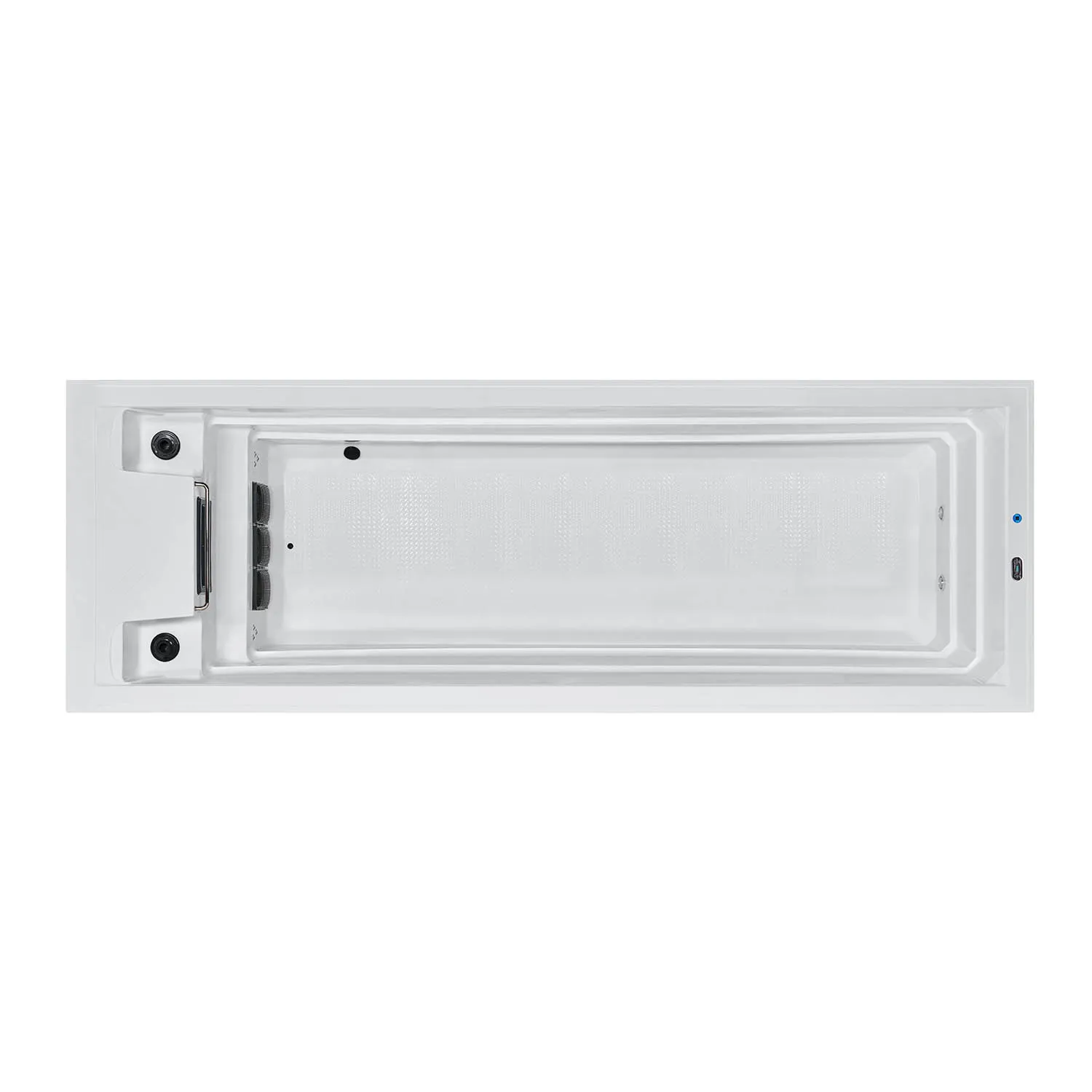
Can swim spa tubs be placed on outdoor terraces or platforms?
This is a question that requires very careful consideration.
For elevated terraces or platforms, the following aspects need special attention:
• Structural load-bearing design
• Beam and column distribution
• Design load standards
The weight of a swim spa tub far exceeds that of ordinary outdoor furniture.
If the platform wasn't originally designed according to these standards:
• There is a very high risk of insufficient load-bearing capacity.
• Serious structural safety hazards.
From a professional perspective, if the platform's load-bearing capacity cannot be clearly confirmed, it is not recommended to place a swim spa tub directly on it.
Why might a seemingly sturdy surface be unsuitable?
This is a point many people easily overlook.
Some surfaces appear very solid, such as:
• Thick wooden platforms
• Slate paving
• Outdoor brick surfaces
But the problem is:
• Hard surface ≠ Stable subbase
• Paving material ≠ Load-bearing structure
Swim spa tubs truly test:
The entire ground structure system, not just the surface material.
If the subbase lacks a stable load-bearing structure, even a stone surface can cause problems.
Why is "long-term stability" particularly emphasized for outdoor swim spa tubs?
Because swim spa tubs have the following characteristics:
• Constant water level
• Continuous weight
• Water flow and human activity during use
• High requirements for levelness
Even slight uneven ground subsidence can lead to:
• Uneven water level
• Abnormal stress on the equipment
• Changes in pipe pressure
• Degraded user experience
These problems often don't manifest immediately but accumulate gradually.
Why is the risk higher if you don't use a concrete surface?
The biggest advantages of concrete floors are:
• Strong integrity
• High resistance to deformation
• Less susceptible to environmental influences
Common problems with non-concrete floors include:
• Localized stress concentration
• Deformation over time
• Difficulty in repair or adjustment
For swim spa tubs, once problems arise with the floor:
• Difficulty in adjustment
• High cost
• Irreversible risk
This is why many professional recommendations still prioritize concrete floors.
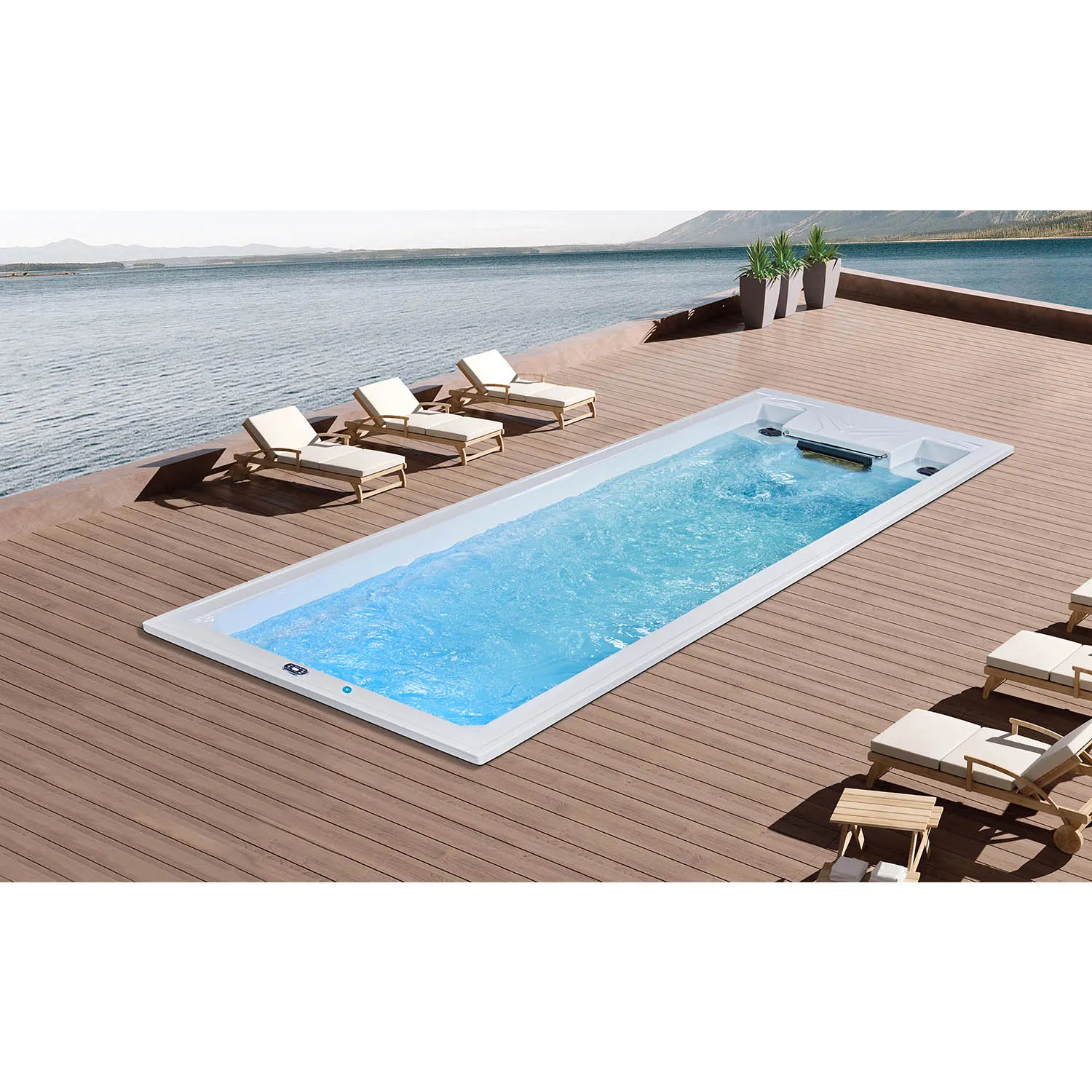
Does a concrete floor mean it "must be cast monolithically"?
Not necessarily, but stability remains the core issue.
The key is not in the "form," but in:
• Whether it forms a monolithic load-bearing surface
• Whether it evenly distributes weight
• Whether it prevents localized subsidence
As long as these principles are met, its essence is equivalent to a concrete foundation.
How sensitive are swim spa tubs to ground levelness?
Very sensitive.
Swim spa tubs are designed based on the following assumptions:
• A level surface
• Even weight distribution
If the surface is uneven:
• The waterline will tilt significantly
• Excessive pressure on one side
• Long-term structural stability will be affected
Concrete surfaces are easier to level precisely during construction, which is one of the main reasons for their widespread adoption.
If the surface is no longer concrete, can it be adjusted?
In principle:
• Minor unevenness can be adjusted
• Structural deficiencies cannot be remedied
If the surface itself is insufficient to bear the weight, simply raising or leveling it will not solve the fundamental problem.
A swim spa tub is not a "temporary" installation; any stopgap measure may become a future hazard.
Why do professional recommendations often favor concrete surfaces?
The reasons are not complicated:
• High safety
• Strong versatility
• Does not rely on complex structures for judgment
• Lowest maintenance risk
For high-value, heavy equipment like swim spa tubs, the first principle for surface selection is "reducing uncertainty."
Concrete surfaces are precisely the easiest solution to reduce uncertainty.
So, must an outdoor swim spa tub be placed on a concrete surface?
The final conclusion can be summarized in one sentence: A swim spa tub doesn't necessarily have to be placed on a concrete surface, but it must be placed on a foundation with equivalent load-bearing capacity and long-term stability. A concrete surface is the safest, most reliable, and most common choice.
If the structural safety of other surface options cannot be confirmed, then:
• Choose a concrete surface
• This is equivalent to choosing the lowest-risk option.
Why Is Yuehua a Trusted Supplier for Global Wellness Products?
Yuehua combines manufacturing experience, modern factory facilities, and a complete product range—from outdoor spa to massage bathtub. As a professional China supplier, we offer high-quality products, flexible customized services, and competitive low prices. Our goal is to help buyers succeed in their markets through reliable supply, clear pricing, and consistent support.