


During the use and maintenance of a swim spa tub, the presence of leaks is an extremely important yet often overlooked issue. Because swim spa tubs have large water capacity, complex structures, and many system components, leaks not only affect normal use but can also adversely impact the equipment's lifespan and the surrounding environment.
However, leaks do not necessarily indicate serious malfunctions. Sometimes, it's simply a natural change in water level or surface condensation, not a true structural leak.
Therefore, learning to correctly determine if a swim spa tub is truly leaking is a crucial skill in its use and maintenance.
This article will systematically explain from a professional perspective how to determine if a swim spa tub is leaking, helping you develop a clear and rational judgment process to avoid misdiagnosis or delayed treatment.

What Constitutes a True Swim Spa Tub Leak?
Before making a judgment, it's essential to clarify one concept: not all "reduced water" or "damp ground" equates to a leak.
A true leak typically exhibits the following characteristics:
• A sustained and abnormal drop in water level within a short period
• Significant water loss even when not in use
• Continuous water accumulation at or around the equipment
• No clear correlation with evaporation or splashing
However, the following situations are often not considered true leaks:
• Normal water level drop due to evaporation
• Water splashing during use
• Condensation on the casing or pipe surfaces due to temperature differences
Therefore, the first step in determining if a swim spa tub is leaking is not to rush into disassembly and inspection, but to accurately distinguish between normal phenomena and abnormal situations.
How to determine if a swim spa tub is leaking based on water level changes?
Water level changes are one of the most intuitive and commonly used methods for determining leaks.
Characteristics of Normal Water Level Changes
Even when not in use, a certain degree of natural water level change will occur in a swim spa tub. The main reasons include:
• Natural evaporation of water
• Changes in ambient temperature
• Large exposed water surface area
In this case:
• The water level drops slowly
• The change is relatively stable
• Usually within an acceptable range
Characteristics of Abnormal Leaking Water Level Changes
If the swim spa tub has a leak, the water level change often has the following characteristics:
• The water level drops significantly faster than normal evaporation
• The water level continues to drop even when the tub is turned off
• The water level may stop dropping after reaching a certain height (corresponding to the leak point height)
Therefore, by continuously observing the water level change trend, a preliminary judgment can be made as to whether there is a potential leak in the swim spa tub.
Why does the water level in a swim spa tub drop even when it is not in use?
This is one of the reasons why many users misjudge the situation.
Water level drops not caused by leaks include:
1. Evaporation
• High water temperature
• Dry ambient air
• Large water surface area
2. Residual water backflow
• Residual water in the pipes flows back into the main water chamber
• The initial water level appears to have dropped
3. Filtration system operation
• Changes in water level distribution during filtration circulation
These situations are all normal operating characteristics of the swim spa tub, not leaks.
How to determine if there is a leak by examining the bottom of the equipment and the surrounding environment?
Observing the surrounding environment is one of the important steps in determining if there is a leak in the swim spa tub.
Areas requiring close monitoring include:
• The bottom of the swim spa tub
• The surrounding floor
• Near the drain outlet
• The base or supporting structure of the equipment
Leaks may manifest as:
• Persistent dampness on the floor
• Recurring water accumulation in localized areas
• Water stains remaining even after cleaning or use
Note that:
Short-term floor dampness may originate from splashes or condensation during use, while persistent water accumulation is more concerning.
Which parts of the swim spa tub are more prone to leaks?
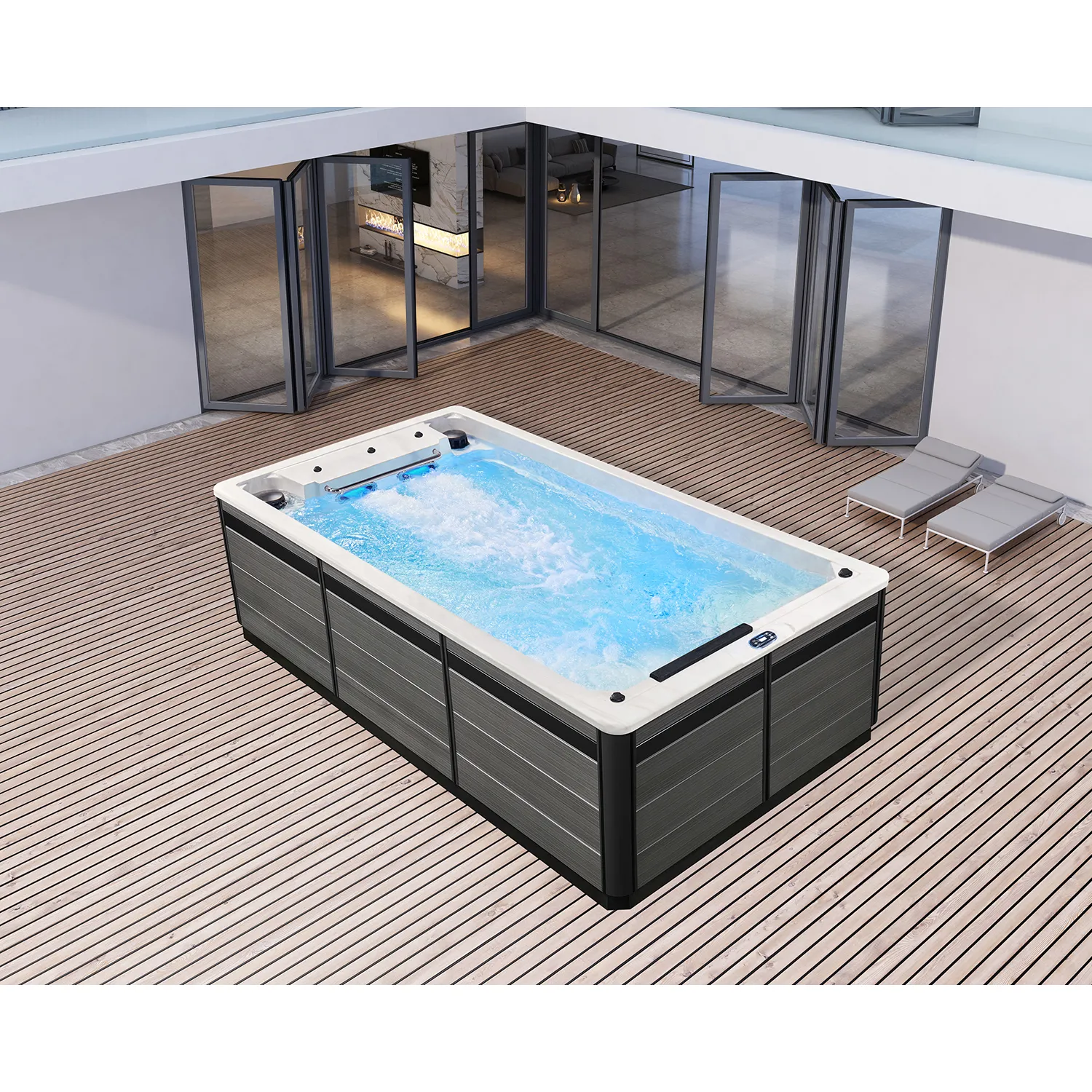
Structurally, the swim spa tub is not a "seamless" tank, but rather consists of multiple systems and interfaces.
Areas more prone to leaks include:
1. Pipe connections
• Inlet/outlet pipe interfaces
• Nozzle connection points
• Pump connection flanges
2. Around nozzles and inlets
• Subjected to long-term water pressure
• Potential for leaks due to aging seals
3. Drainage system areas
• Drain valves
• Drain outlet sealing structures
4. Bottom area of equipment
• Hidden areas of internal piping
• Water pooling downwards after a leak
Understanding these high-risk areas helps in more targeted inspection when diagnosing leaks.
Can the location of a leak be determined by the "water level stopping point"?
This is a very professional and effective diagnostic approach.
Explanation of the principle: If a leak exists at a certain height in the swim spa tub:
• When the water level is above the leak point, leakage will continue.
• When the water level drops below the leak point, leakage will stop.
Therefore, if you find that:
• The water level always drops to a certain fixed height and then stops,
it likely means that:
The leak is located near or slightly below that water level.
This method is particularly applicable to swim spa tubs because their water level is relatively fixed.
What are the differences between leak detection in running and stationary states?
Leakage in swim spa tubs may manifest differently in different states.
In a stationary state:
• The pump is not running.
• Water pressure is relatively stable.
• Natural seepage is easier to observe.
Suitable for detecting:
• Structural leaks
• Chronic seepage at joints
In a running state:
• The pump is running.
• Pressure in the pipes increases.
• Some leaks only become apparent during operation.
Therefore, observing both stationary and running states provides a more comprehensive assessment of whether a swim spa tub is leaking.
Can condensation be mistaken for a leak in the swim spa tub?
Yes, and this is a very common source of misdiagnosis.
Causes of condensation:
• Water temperature higher than ambient temperature
• High air humidity
• Significant temperature difference between pipe and casing surfaces
Condensation typically has the following characteristics:
• Small volume
• Evenly distributed
• Varies with environmental changes
A true leak usually exhibits the following characteristics:
• Concentrated in a specific location
• Continuous occurrence
• Related to operating status or water level
Distinguishing between condensation and a leak is an essential step in diagnosing a swim spa tub leak.
How can sound and operational anomalies aid in diagnosing a leak?
While not direct evidence, changes in operating status can serve as supplementary evidence.
Potential anomalies related to leaks include:
• Frequent pump replenishment
• Abnormal drop in water pressure
• Malfunction of the filtration system
These phenomena alone cannot confirm a leak, but when combined with water level changes and external observations, they can serve as important reference signals.
Why is timely detection of swim spa tub leaks so important?
If a real leak in a swim spa tub goes undetected for an extended period, it can lead to:
• Waste of water
• Dampness buildup inside the tub
• Damage to the surrounding ground or foundation
• Further deterioration of the piping system
Therefore, early and accurate leak detection is far more important than blindly attempting repairs or ignoring the problem.
Who is Yuehua as an outdoor spa and swim spa manufacturer?
Guangdong Foshan Yuehua Sanitary Ware Co., Ltd. is a professional Chinese manufacturer specializing in outdoor spas, swim spas, sauna rooms, outdoor gazebos, steam bathrooms, and massage bathtubs. Established in 1995, Yuehua has grown into a reliable factory with over 40,000 square meters of production space and advanced manufacturing equipment. As a direct supplier and exporter, we provide high-quality products for global wholesale, OEM brands, and project purchasing.